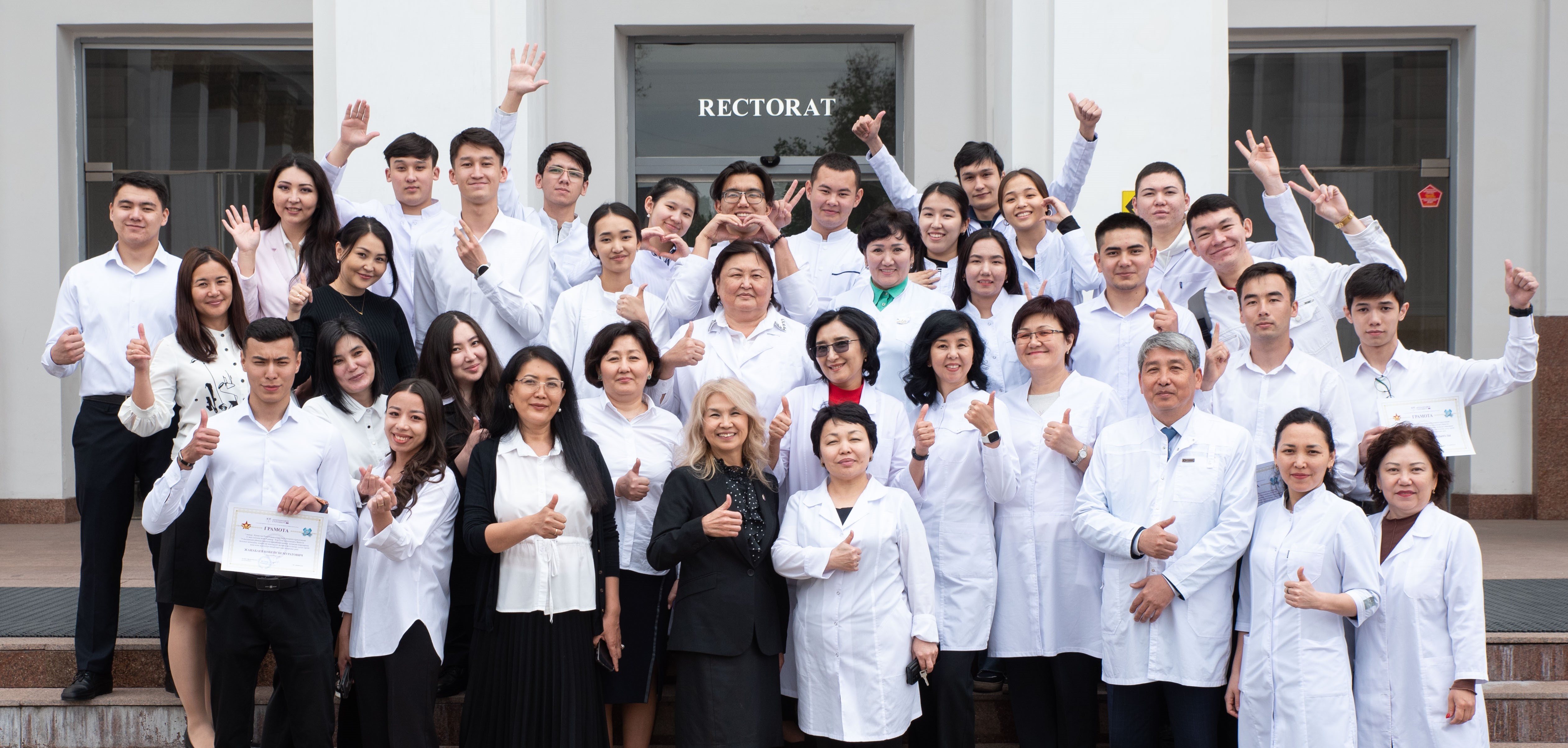
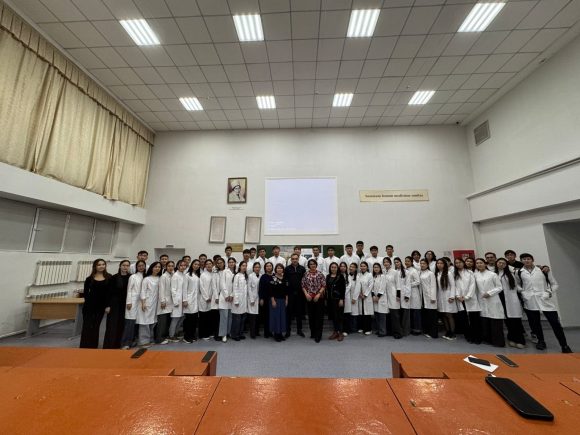
On November 12, 2025, the curators of the Department of Molecular Biology and Medical Genetics, G.T. Taneeva and K.E. Zhuzzhan, conducted a debate session with first-year students of the “Medicine” specialty from groups M25-001/002 and M25-003/004 on the topic: “The 180th Anniversary Legacy of Abai: The Intersection of Classics and Artificial Intelligence.” During the event, the Head of the Department, A.Zh. Moldakaryzova, and the Deputy Dean, K.F. Amantaev, delivered speeches.
The debate was held in two directions:
1st Direction: Abai’s Works – Eternal Values
Students analyzed the educational and moral significance of Abai’s Words of Edification and poems, as well as their relevance in modern society.
Within this direction, students thoroughly discussed the deep educational, ethical, and spiritual meaning of Abai Kunanbaiuly’s works. Each team expressed their views based on key concepts found in Abai’s writings, such as diligence, honesty, the pursuit of knowledge and science, human duty, modesty, honor, and the concept of the “complete human.”
Students cited excerpts from the 7th, 14th, 19th, 25th, and 38th Words of Edification,
demonstrating their relevance today. Abai’s ideas—
“A person’s humanity depends on intellect, knowledge, good parents, good friends, and good teachers,”
“Avoid five qualities, strive for five qualities,”
“Aspiration, labor, deep thought…” were viewed as important life guidelines.
Students also emphasized that Abai’s reflections on the education of the human inner world, character formation, justice, and responsibility in society remain significant today. During the discussion, it was highlighted that Abai’s works influence not only the personal development of young people but also play an important role in shaping the ethical culture of future medical professionals.
The conclusion was drawn that Abai’s legacy represents eternal values, and his ideas continue to reveal new meanings, guiding younger generations toward spiritual growth.
2nd Direction: The Intersection of Classics and Artificial Intelligence
In this direction, students discussed the potential for interaction between classical literary heritage—particularly the works of Abai—and modern technological advancements, especially artificial intelligence (AI). The debate explored new interpretations of Abai’s ideas in the digital era, contemporary formats of their application, and the role of AI in education and science.
Students highlighted the potential of AI in the following areas:
analyzing Abai’s texts using digital tools;
generating text in the style of Abai and comparing it with original works;
using AI as a supplementary educational tool for studying literature;
promoting Abai’s works at the international level through modern technologies;
identifying the advantages and limitations of using AI when working with classical texts.
The discussion allowed students to conclude that the combination of classical literature and modern technologies represents harmony between tradition and innovation, and that artificial intelligence, when used correctly, can serve as a tool for human spiritual and intellectual development.
